
Root Canal vs Tooth Extraction: Which Is Better for You?
When a tooth is badly decayed or infected, there are only two real options left: save it with a root canal, or remove it. It is one of the most common questions we are asked in the clinic, and the honest answer is that neither one is always right.
The short answer
In most cases a root canal is the better choice, because it saves your natural tooth and costs less overall. Extraction is better only when the tooth is too damaged to be saved. Remember that removing a tooth is not the end of the treatment — the gap still has to be filled later with an implant or a bridge, and that costs much more than the root canal would have.
Below we compare both options honestly on cost, time, recovery and what you are left with at the end, and explain when each one is actually the right choice for you.
What is the real difference?
Both treatments solve the same problem, which is the infection and the pain. The difference is what happens to the tooth.
In a root canal treatment, the infected pulp is removed from inside the tooth, the canals are cleaned and sealed, and the outer tooth stays in your mouth. You keep your own tooth and it continues to work normally.
In an extraction, the whole tooth is taken out, root and all. The infection goes with it, but so does the tooth, and you are left with a gap that will need to be filled later.
Root canal or extraction — side by side
The same infected tooth, treated two different ways.
Root canal treatment
The tooth
Saved and stays in place
Visits needed
Usually one, sometimes two
Recovery
Mild soreness for two to three days
Chewing
Normal, as before
Jaw bone
Stays healthy, because the root is still there
Treatment after this
A crown, and then it is finished
Total cost
Root canal plus crown
Tooth extraction
The tooth
Removed completely
Visits needed
One, plus more for the replacement
Recovery
One to two weeks for the socket to heal
Chewing
Affected until the gap is filled
Jaw bone
Starts shrinking where the root used to be
Treatment after this
An implant or a bridge, months later
Total cost
Extraction plus implant or bridge
Extraction looks cheaper on the day of the treatment. It is usually the more expensive option by the time the gap has been filled.
Why saving the tooth is usually better

No artificial tooth, however good, works quite like the one you were born with. There are four solid reasons dentists try to save a tooth first.
Your bite stays the same
Your teeth are positioned to meet each other correctly. Remove one and the teeth beside it slowly tilt into the gap, while the tooth above it drifts down. Over years this changes your whole bite.
The jaw bone stays healthy
The root keeps the bone around it active. Once the root is gone, the bone in that area slowly starts to shrink. This is why implants placed years after an extraction sometimes need a bone graft first.
It costs less overall
A root canal with a crown finishes the treatment. An extraction is only the first step, and the implant or bridge that follows usually costs more than the root canal would have.
It is finished sooner
A single sitting root canal and a crown take a couple of weeks. An extraction followed by an implant can take three to six months, because the bone has to heal first.
When extraction is the right choice
We would be giving you bad advice if we said a root canal is always possible. Sometimes a tooth genuinely cannot be saved, and trying to save it only wastes your time and money. Extraction is the better option when:
- The tooth is cracked below the gum line. If the crack runs down into the root, there is no way to seal the tooth properly and the infection will keep coming back.
- Too little tooth is left. A crown needs something solid to sit on. If decay has destroyed most of the tooth, there is nothing left to build on.
- The supporting bone is badly damaged. In advanced gum disease the tooth becomes loose because the bone holding it has been lost. A root canal does not fix that.
- A previous root canal has failed twice. Retreatment is often possible once. If the infection returns again after that, removing the tooth is usually the sensible decision.
- It is a wisdom tooth. Wisdom teeth are not needed for chewing and are very hard to clean properly, so they are normally removed rather than treated.
In all of these cases the tooth is beyond saving, and holding on to it only risks the infection spreading to the bone and to the teeth next to it.
What happens after an extraction?
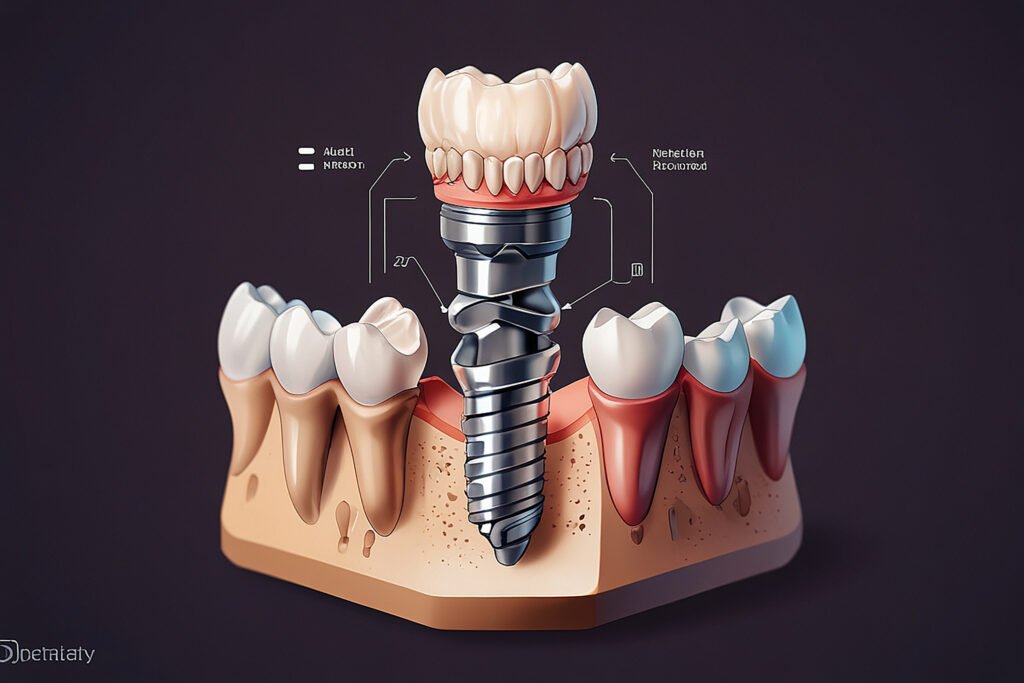
This is the part people often do not think about when they choose extraction because it seems cheaper or quicker.
Once a tooth is out, the gap has to be filled. You can have a dental implant, which is the closest thing to a natural tooth, or a bridge, which uses the two teeth on either side for support. Both are proper treatments in their own right, with their own cost and their own timeline.
Leaving the gap empty is not really an option for a back tooth. The neighbouring teeth drift, the opposite tooth grows down into the space, food gets trapped in the gap, and chewing shifts to the other side of your mouth.
How we decide in the clinic
We never decide this from looking at the tooth alone. The steps are always the same:
A digital X-ray
This shows how far the infection has spread, the shape of the roots, and whether the bone around the tooth is still healthy.
Checking how much tooth is left
We look at how much healthy tooth structure remains above the gum, because that decides whether a crown can be fitted afterwards.
Explaining both options to you
We tell you what each option will cost, how long each will take, and what the tooth is likely to be like in ten years. The decision is then yours, and we will tell you plainly if we think one option is clearly better.
Not sure if your tooth can be saved?
Come in for a consultation and an X-ray. We will tell you honestly whether the tooth can be saved, what each option costs, and how long it will take — before any treatment is started.
See our root canal treatment